The anatomy of speech

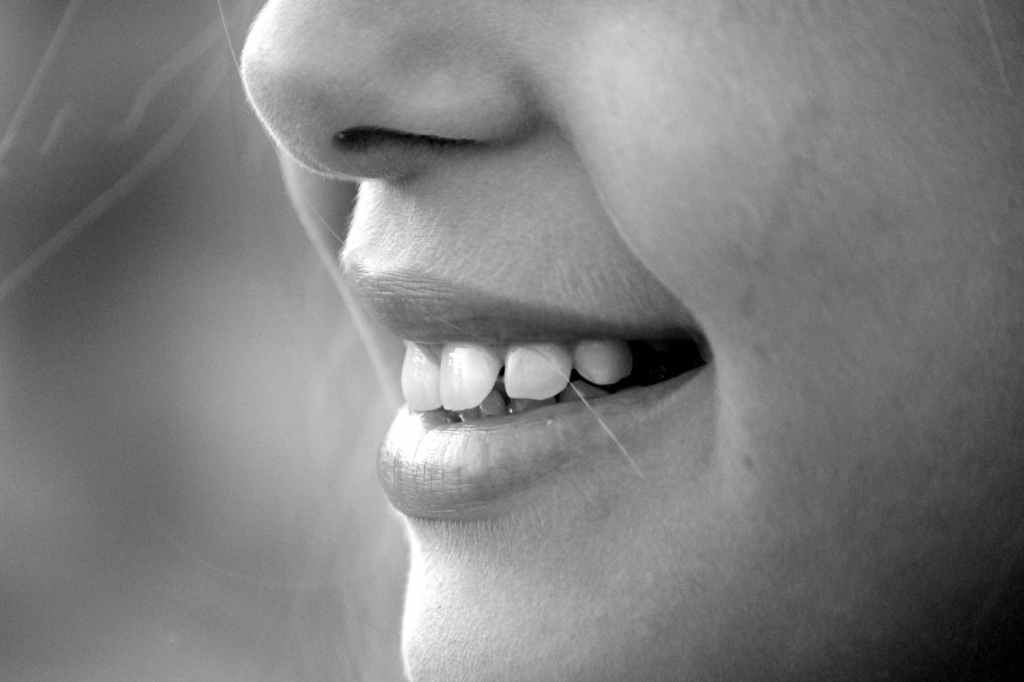
Photo by Pixabay on Pexels.com

Have you ever thought about how you talk? I don’t just mean the way that you say certain words, or maybe the fact that you slur your words after a few too many drinks. I mean HOW you talk. The anatomy of the mouth and the way that your tongue does such quick and precise movements is truly fascinating. I also want to issue a pre-emptive apology because if you are anything like me, after reading this you will spend way too much time being aware your tongue. But enough of the preamble, let’s just get into it.

If you think about it for too long, tongues are just gross muscular things in our mouths. We use them when we eat to move food around in our mouths and to get food that was trapped between our teeth free, and of course they are primarily responsible for tasting. An often underappreciated function of tongues is their involvement in speech. This is not to say that tongues are essential for all speech, but they play a major part in the formation of both consonant and vowel sounds.

For reference, of the 23 English consonants in the International Phonetic Alphabet, only 7 of them do not directly involve the tongue. But this is just a little taste of what is to come. For now, lets talk about all of the things we need to classify a sound. When it comes to identifying a sound, there are three things we need to consider: voicing, place of articulation, and manner of articulation.

Voicing is not something that involves the tongue at all, but it is something that we have talked about previously. As a reminder, voiced sounds are produced with your vocal folds being held close together so they vibrate when air passes through them. You can feel this in a word like “zit” by placing your fingers on your neck as you say it. Compare this to a word like “sit” which has a voiceless sound at the beginning. Voiceless sounds are produced by keeping your vocal folds spread open so that there is no vibration.

Moving up from the vocal folds, let’s get back to the tongue. We will begin talking about the tongue by discussing the different places of articulation. The places of articulation are mostly self explanatory with names like inter-dental (between the teeth) and bilabial (involving both lips), but the one we will discuss first deals with the “s” and “z” sounds we have discussed previously. These sounds are classified as alveolar sounds, meaning that they are articulated with the tongue at a place in your mouth known as the alveolar ridge. The alveolar ridge is just behind your upper front teeth and if you feel around with your tongue, you can feel a small protuberance where the roof of your mouth raises slightly. The diagram below shows a mid sagittal cross section of an oral cavity which shows the alveolar ridge, and all of the other places of articulation in the mouth.
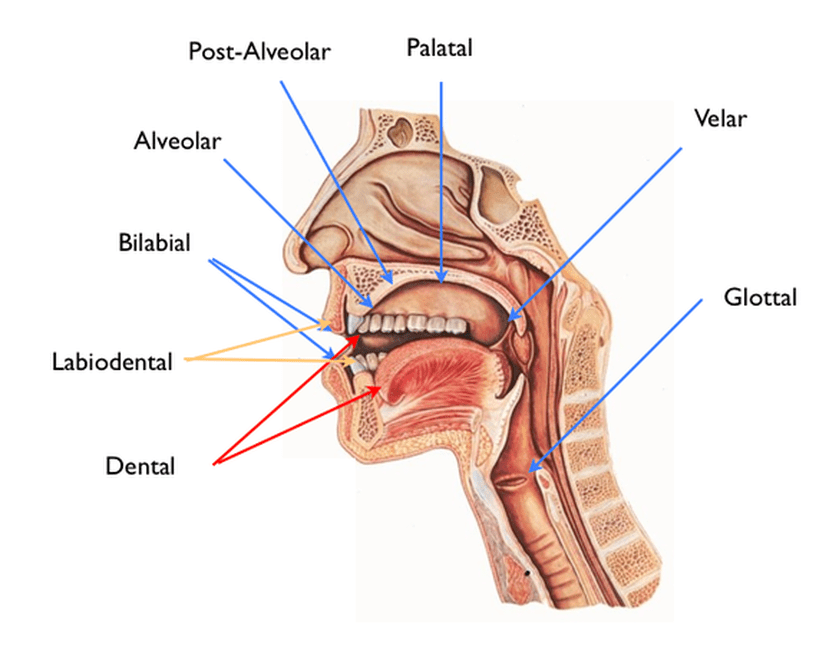
Places of articulation

Not all of these places involve the tongue as we previously discussed. All bilabial sounds like “b”, “p” and “m” are produced with only the lips and the tongue is not involved at all. Sounds like “f” and “v” combine two articulators (the teeth and the lips) to produce sound and these are known as labiodental sounds which, again do not use the tongue.

Before we move onto the manner of articulation, I want to talk about “r” for a second. “r” is a unique sound in English because it can be produced in two different ways depending on how you move your tongue. So now is when I ask you, are you a buncher or a curler?

To figure out whether you are a buncher or a curler, there is a simple test you can do. Go grab a toothpick or something similar that you are comfortable putting in your mouth and just poke your tongue as you are producing an “r” sound. If the thing you are poking is the bottom of your tongue, congratulations, that means you are a curler. If you are poking the top, then also congratulations, you are a buncher.

It turns out that an “r” sound can either be produced by curling your tongue tip back toward the rear of your mouth, or by just bunching up your tongue blade toward the back of the tongue. It is important for speech language pathologists to know about this so they can be prepared to teach techniques for both of them. There is no advantage or disadvantage to either technique, bunchers and curlers can both produce “r” sounds just fine.  This is just a weird quirk of our bodies that we can observe.

Now back to the different sounds. Let’s talk about manner of articulation. Manner of articulation deals with the finer aspects of the tongue and how it directly impacts the airflow in the oral cavity. For example, lets return to the “s” and “z” alveolar sounds that we talked about earlier. These sounds are known as fricatives because they are produced by having the tongue very close to the place of articulation, but not touching it so that there is a small amount of space between them that results in a small amount of frication in the airflow, hence the name.

So now think about a sound like “t” or “d”. These sounds are both alveolar sounds as well, but they are produced by having the tongue touching the place of articulation and momentarily stopping the airflow entirely. Unsurprisingly, these are called stops. Now what about a sound like an “n” or an “m”. When you produce these sounds, you are producing them like you would a stop, but you can feel a little bit of reverberation in your sinus as you are producing them. These sounds are nasal stops, and they are produced by lowering the velum at the back of your oral cavity which allows the air to flow into your nasal cavity and resonate like that.

The amazing thing about all these actions is that they are not things that you actively need to think about to do. In fact, you probably put zero thought into how this works until you read this post. Our bodies can do all of this effortlessly and automatically.

As always, this is just a brief overview. We don’t have time to get into all the different places and manners of articulation. We will likely return to talk about more unique language sounds (like clicks), but for now, I think this is a good place to leave it.

Thank you for reading folks! I hope this was informative and interesting to you. Be sure to come back next week for more interesting linguistic insights. If you have any topics that you want to know more about, please reach out and I will do my best to write about them. In the meantime, remember to speak up and give linguists more data.

When you can’t see the sentence for the trees

Syntax is the greatest subfield of linguistics and I say this as a syntactician with absolutely zero bias (wink wink). The field of syntax cares about the ordering of words in a sentence, and the operations that took place to create the word order known as the derivation. The thing that I love about syntax is that is basically a series of math and logic problems. We can take a sentence and work backwards from it to learn how it was constructed. Now before everyone panics about the fact that I am trying to equate math and language lets all just take a deep breath and I will walk us through how a syntactic derivation works.

Photo by Brandon Montrone on Pexels.com

Before we start talking about full sentences though, we need to start a little bit smaller. We will start by talking about verbs. A verb, as you already know, is an action word that tells us what happened, what is happening, or what will happen depending on the tense used. Think of the verb in a sentence as the conceptual seed of a sentence. There are three major verb types that we will talk about today that are separated based on how many arguments they have. These verb types are transitive, intransitive, and ditransitive.

When you picture a basic sentence with a subject, a verb, and an object, you are likely picturing a transitive verb. Transitive verbs are verbs that have two obligatory arguments (the subject and the predicate). What this means is that the information contained in a sentence with a transitive verb includes: an action (the verb itself), the thing that is doing the action (the subject), and the thing that the action is happening to (the predicate). For instance, you can take the verb ‘discuss’ as a good example of a transitive verb. ‘Discuss’ needs at least two arguments (nouns in this case) in order to create a grammatical sentence. This means that you are no able to say something like “John discussed.” or “Discussed the contract.”, you would need to say “John discussed the contract” (Note that you can say “Discuss the contract!”. This is a null subject imperative though and we will talk about those another time).

So, to bring the math connection back around; one way that we can represent sentences like “John kicked the ball.” is by using parentheses. It would look something like this:

                [John [discussed [the contract]]]

Now I am simplifying things quite a bit from how it would actually be represented, but for the purposes of this article it’s good enough. Let’s break down the bracketing so you can see why it is organized like this. In the innermost layer, we have “the contract” which is the thing that is being discussed. This is why it is contained within the bracketing for the verb “discuss” because there is a connection between these two words. On the outermost layer, we have “John”, who is the one that is doing the discussing. “John” has the verb contained within his bracketing because he has the same sort of connection to the act of discussing that the action of discussing does to the contract. Again, this is simplifying things a bit, but I am just trying to explain why we have this embedded bracketing as opposed to something like [John][discussed][the contract] where there is no clear connection between any of the words.

Now, lets branch out to the other verb types. Intransitive verbs are verbs which only have one obligatory argument rather than two. Intransitive verbs are a little bit tricky because they are actually divided into two subtypes, unergatives and unaccusatives. Full disclosure; I constantly get tripped up on the difference between these two because it is subtle and a little unintuitive, but it is my hope that maybe teaching people about it on the internet will also help to clear it up in my head!

The biggest difference between these two verbs deal with whether their subject is semantically an agent or not. If you kick something or hit something, then YOU are a semantic agent in that case because (it is safe to assume) you are doing those things intentionally. Conversely, if you fall, it is not likely that you are doing this on purpose so we can say that you are not the agent in this case but rather that you are the experiencer; the one who experiences the fall.

Unergative intransitive verbs are single argument verbs that only have an obligatory subject (which is a semantic agent) and no obligatory object. I have used the word obligatory twice in this sentence to really drive home the fact that there is a difference between an object that needs to be there and one that does not. Take the sentence “John ate the cake” for example. This sentence has two arguments, “John” and “the cake”, but the fact that it has two arguments does not make it transitive. It is perfectly grammatical and acceptable to simply say “John ate” and leave “the cake” off of it. This is because “the cake” is an optional argument in this sentence, or what we call an ADJUNCT argument in syntax terms. Adjuncts are optional arguments that can be removed without making the sentence ungrammatical.

So we see that a verb like “eat” is a great example of an unergative verb because you only need to specify the thing that is doing the eating, and you are not required to specify the thing that is eaten. Other good examples are things like “run” or “walk” because they are things that require intent and agency to do, but there is no need to specify where you are running or walking to. You can simply just specify that movement is occurring and leave it at that.

An unaccusative intransitive verb is a verb whose subject is not a semantic agent. The best example of an unaccusative sentence would be something like “the tree fell” or “the window broke” because things like trees and windows do not have any agency and are certainly not falling or breaking on their own accord. It is also important to note that unaccusative verbs cannot have any type of object after the verb.

Both unergative and unaccusative verb sentences have simple bracket representations like this:
                [John [ran]]

                [The tree [fell]]

The third type of verb that we will talk about is the ditransitive verb. A ditransitive verb is a verb that requires three arguments (two nouns and a preposition usually) in order to be grammatical. Take the verb “put” for instance. You can’t use “put” as a transitive verb and simply say something like “John put the book”, you also need to specify where the book was put! This is why we would need to make it “John put the book on the table” instead. The labeled bracketing for these ditransitives gets a little more complicated:

                [John [put [the book][on the table]]]

Now keep in mind that these are just simple sentences, but you can imagine as they get bigger and more complex that the labeled bracketing will become very hard to read. Luckily, syntacticians have figured out a more visually pleasing way to represent these sentences that serves the same purpose. Allow me to introduce you to the sentence tree:

John put the book on the table

These trees are drawn with a program known as LaTeX, which is a typesetting used in many scientific and academic settings. If you haven’t worked with LaTeX before, it is hard to describe but it is essentially a halfway point between typing and programming. For example, for this sentence tree above I had to provide LaTeX with a command to draw the tree, and that command makes use of the bracketing that I have been talking about all along. Here is the command that I used:

\documentclass[12pt]{article}
\usepackage{qtree}

\begin{document}

\Tree [ John [ put [{the book} {on the table} ] ] ]

\end{document}

So essentially, this command is taking the same information that is contained in the bracketing and turning it into a visual representation that allows us to easily see how all of the parts connect without having to count all of the brackets by hand.

Now my biggest fear at this point is that my supervisor will somehow stumble across this post and think less of me for these trees. It is at this point I will remind you that there is SOOOOOOOO MUCH that I am glossing over. I am just trying to give a brief overview of the things that I do so that people like my mom will have a better understanding of some of the things that I do. There are entire four-month university courses dedicated to almost all of the subjects that I talk about on this blog so I can’t talk about them all in detail, but if people are interested, I will certainly keep writing more about it. I am a syntactician at heart and I could go on about this stuff until I pass out, but I don’t want to keep you here forever either.

This is a logical stopping point for this one, but I am sure that I will be returning to syntax again in the future so keep an eye out for that. Thank you for reading folks! I hope this was informative and interesting to you. Be sure to come back next week for more interesting linguistic insights. If you have any topics that you want to know more about, please reach out and I will do my best to write about them. In the meantime, remember to speak up and give linguists more data.