The Fan-fkn-tastic Rules of Language

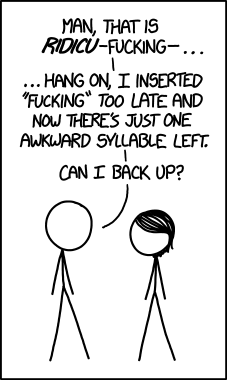
Whether its to express anguish or to emphasize something excitedly, The F Word is a versatile word within the English language. We all know that it can be a noun, a verb, and an adjective already, but a lesser discussed feature of it is what It can do inside of a word. The ability to insert The F Word into the middle of a word, or infix it, is constrained by the underlying structure of the word.

Take the word “fantastic” for example. It’s a three-syllable word with no prefixes of suffixes. We can easily insert The F Word after the first syllable and end up with something like “fan-fkn-tastic”, but we can’t put it between the second and third syllables to make something like “fanta-fkn-stic” (or fantas-fkn-tic depending on how you want to divide it).

You can probably think of some other three syllable words that pattern the same way so you might try to generalize that The F Word can be inserted between the first and second syllable of a word. But what about a four-syllable word like absolutely. You can “abso-fkn-lutely” break it up like this, but it’s “ab-fkn-solutely” weird to put it anywhere else.

So what can this tell us about the structure of these words then? If it’s not just about the syllables, what is constraining where we put The F Word? This is where we need to talk about the concept of a prosodic foot. This is a concept that you may already be familiar with if you study poetry.

Essentially, a prosodic foot within a word is what gives us a sense of rhythm within a word. Prosodic feet are composed of two (disyllabic) or more syllables in a word, one of which is stressed or “long”, and the rest being unstressed or “short” (there are cases of all stressed syllables and all unstressed syllables in a foot, but we won’t be talking about those today). The two most common types of disyllabic feet that you have likely heard of are iambic feet and trochaic feet. In an Iambic foot, the second syllable will be stressed while in trochaic feet, the first syllable will be stressed. Iambic feet are pretty well known thanks in part to William Shakespeare and his penchant for writing in an iambic rhythm.

With these definitions in mind, lets review some of the words from above:

If we assign a beat structure of sorts to these words where “DUM” is a stressed syllable and “da” is an unstressed syllable we can see that they both have uniquely different rhythms.

Fantastic – da-(DUM-da)

Absolutely – (DUM-da)-(DUM-da)

The two words shown here both happen to have trochaic feet where the first syllable in the foot is the one that is stressed. So now we can adapt our rule to say that the F word can only be infixed in front of a foot.
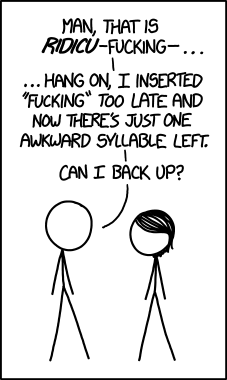
xkcd #1290

Of course, this just wouldn’t be English if there weren’t a few exceptions to the rule. What about a more complex words like “unbelievable”? I think we can all agree that “un-fkn-believable” sounds a lot better than “unbe-fkn-lievable”. Linguists have adapted the rule to prioritize morphological boundaries of a word over the rhythm and foot structure in these cases, and because the “un” in this word is a prefix that attaches to the word “believable”, we would prefer to separate it for the sake of infixing than to use the rhythm structure and leave behind this “unbe” thing.

Now think about a word like Kalamazoo. You might be okay with both “Kala-fkn-mazoo” and “Kalama-fkn-zoo”. Maybe you have a strong preference one way or the other. At the end of the day, there is no perfect answer to the problem of where we can infix The F Word in English, but there are certainly some interesting things you can do with it. I encourage you all to go out there and see what you can F up!

Thank you for reading folks! I hope this was informative and interesting to you. Be sure to come back next week for more interesting linguistic insights. If you have any topics that you want to know more about, please reach out and I will do my best to write about them. In the meantime, remember to speak up and give linguists more data.

Prescriptive vs. Descriptive: Not your English teacher’s English

Photo by cottonbro on Pexels.com

In my last post, I talked about how it isn’t my job to dictate what happens with a language, or to tell you how language should be used. You may be asking yourself “wait, if linguists don’t make the language rules, then what do they even do?” It’s a valid question, and frankly one that I am still figuring out every day. The best analogue that I can come up with is Dr. Jane Goodall and her chimpanzees.

Dr. Goodall began her career of working with primates in the early 1960’s by observing them from a distance and simply observing their behavior and taking notes. Over time she did interact with them, but it was passive interactions, and it was always led by the primates, never forced upon them. She never tried to walk in and change the way that the chimps lived their lives.

Photo by Nirav Shah on Pexels.com

In this metaphor, while I am implying that linguists act like Dr. Goodall, I am not implying that you the reader are the wild primate. Language is the natural, everchanging thing that we linguists are observing and documenting every day. Some of that may involve studying human behavior and how humans utilize the tools that they have when using language such as their vocal tract, but often, it’s the language itself we are most interested in.

So why do we have grammar classes in school? Well, the ability to communicate in a professional manner is certainly a valuable skill in our society still. After all, without grammar rules and at least some form of writing training, there would be no way for this post to be universally comprehensible.

The approach that your high school English teacher took when teaching you how to write a paper or a poem is what we call a prescriptive approach. A prescriptive approach to grammar is one that seeks to prescribe one system in preference to another. On the other hand, a descriptive approach is one that tries to simply describe human linguistic ability and knowledge.

So why don’t linguists just take a prescriptive approach and tell people how to use language? Well think about that high school English class for a second. Sure, you probably learned how to write in an active voice as opposed to a passive voice. Maybe you even learned how to read into metaphors and how to interpret poetry. The things you learned in that class likely don’t make their way into your everyday life in all those ways though. When you are out casually talking with your friends, you probably aren’t sitting there telling them that they should stop ending their sentences with prepositions (at least I hope not).

When it comes to trying to dictate language change, it’s a bit like trying to paddle against a strong current. You probably aren’t going to get very far, and its likely way more fun to just sit back and see where the current takes you. This is the approach that linguists take to language. Rather than trying to force a system to behave a certain way, we choose to observe, document, and unravel the natural changes as they happen. Even small changes to a language can lead to massive amounts of research and a new understanding of how languages around the world adapt.

So the next time you want to yell at your friends about whether it’s “to who” or “to whom” they are speaking with, just sit back and think about why they are saying it that way rather than telling them right versus wrong.

Thank you for reading folks! I hope this was informative and interesting to you. Be sure to come back next week for more interesting linguistic insights. If you have any topics that you want to know more about, please reach out and I will do my best to write about them. In the meantime, remember to speak up and give linguists more data.

It’s raining outside, but what is “it” all about?

It is raining outside.

It seems to be raining outside.

There appears to be a rainstorm blowing in.

Photo by Jill Burrow on Pexels.com

Apart from talking about some gloomy weather, these sentences also share another common thread. Think about the subjects of these sentences. What does “It” mean? Where is “There”? Why do we even need them in these sentences?

These types of pronouns are known as expletive pronouns (no, not those kind of expletives, that’s for another post). These expletive pronouns, also known as pleonastic pronouns or dummy pronouns, act as placeholders in languages that have a strict requirement for subjects. English is a language that really wants to have a subject, regardless of whether that subject actually means anything. Compare the examples above to these sentences:

Is raining outside.

Seems to be raining outside.

Appears to be a rainstorm blowing in.

Just reading these sentences, you probably got a queasy feeling in your stomach telling you “oh, I don’t like this at all”. That’s your native intuition as a speaker of English kicking in to tell you that those are not grammatical sentences. But some of these sentences are only bad because you are reading them as opposed to hearing them. Listen to this clip from Pawnee’s own Leslie Knope.

Parks and Recreation: Season 5 Episode 19

Seems to me we oughta use it.” When we read sentences without subjects, it provokes a stronger reaction compared to hearing someone say it, especially in the quick, casual register used in the clip above.

So what does this mean for the English language as a whole? Well, its hard to say for sure. It could be that we are witnessing a gradual language change where we are becoming more comfortable with ditching these meaningless expletive pronouns in our speech. After all, there are languages that are able to talk about the weather without the need for expletive pronouns.

In a language like Italian you can say “sta piovendo” where the “sta” is would be a verb like ‘be’ in English, and “piovendo” of course means ‘raining’. The word for word translation for a phrase like this would be “is raining”, and if you ask someone who speaks Italian, they likely wouldn’t get the same queasy feeling from “sta piovendo” that you get from “is raining”.

English isn’t the only language that requires these dummy pronouns to describe the weather. Germanic languages all require these pronouns in sentences, even if they don’t refer to anything at all. In German for instance, the phrase “es regnet” translates into English as “it rains”, where again, the ‘it’ doesn’t refer to anything in particular, but it needs to be there for the phrase to make sense (let’s ignore the lack of a verb and tense for the sake of simplicity here).

But is English changing? As a linguist, it’s not my job to try and dictate what should happen to language or to tell you to do the same either. What I can say though is that this might be something to keep your ears open for. Language phenomena have this funny way of sticking in your brain once you know about them. These expletive pronouns are something that may have gone completely unnoticed by you for most of your life, but now that you know a little bit more about them, you will probably notice them a lot more often. If this is the result of natural language change happening in real time, maybe the next time the rain is falling wherever you are you can go outside and scream “IS RAINING!” to get people used to this change a little bit faster.

Thank you for reading folks! I hope this was informative and interesting to you. Be sure to come back next week for more interesting linguistic insights. If you have any topics that you want to know more about, please reach out and I will do my best to write about them. In the meantime, remember to speak up and give linguists more data.